How legal document drafting workflow works
A legal document drafting workflow is a structured, sequential process that moves a document from initial request through template generation, legal review, and final approval, producing consistent, compliant outputs at every stage. Legal professionals and compliance officers who understand this process gain a direct advantage in reducing errors, meeting regulatory obligations, and cutting turnaround times. The rise of AI tools, document automation platforms, and frameworks such as ABA Formal Opinion 512 has fundamentally changed how legal document creation works. This guide covers every stage of the workflow, the role of automation, and the best practices that separate high-performing legal teams from those still relying on ad hoc processes.
What are the main stages in the legal document drafting workflow?
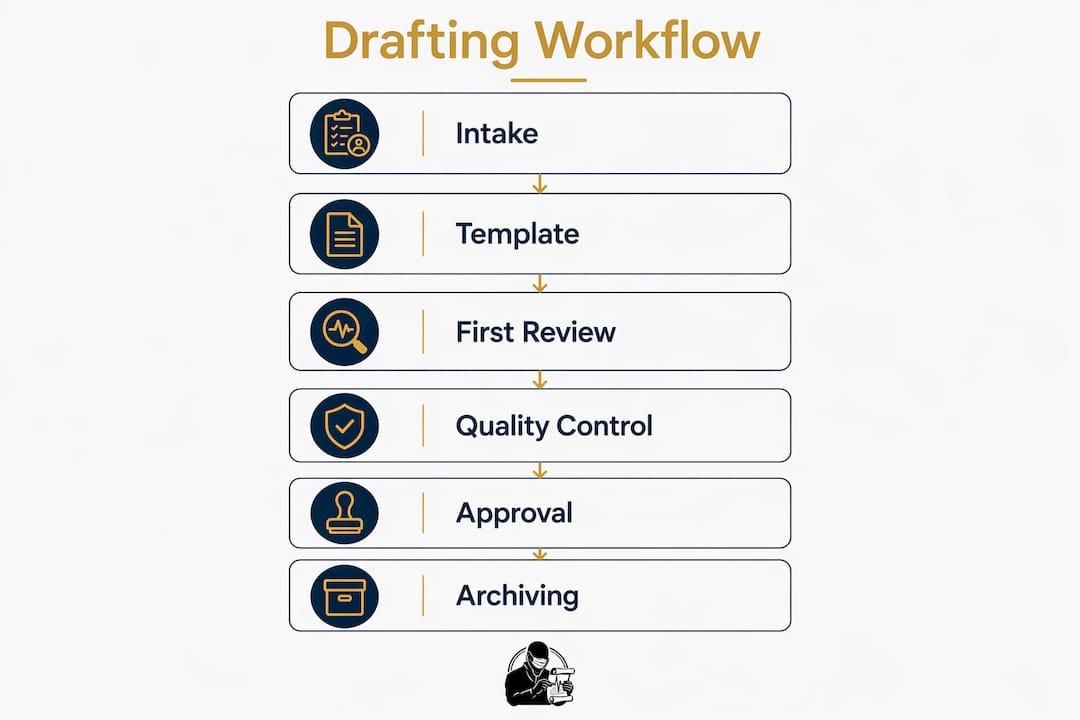
The legal document drafting workflow follows a defined sequence. Skipping or conflating stages is the single most common cause of version errors, compliance gaps, and missed approvals. Structured workflows automate document creation using approved templates and routing for review and approvals, improving consistency and efficiency across the team.
The core stages are:
- Request intake and data collection. A structured intake form captures the matter type, parties, jurisdiction, and any specific instructions. Accurate intake data prevents downstream errors and reduces revision cycles.
- Template selection and document generation. The intake data populates an approved template. Templates should contain layout and clause structure only, with client data injected at generation time. This separation improves security and audit compliance by keeping personally identifiable information out of the base template.
- First-pass legal review. A qualified lawyer or paralegal reviews the generated draft for accuracy, completeness, and jurisdictional fit. This stage catches errors introduced during generation.
- Quality-control review. A second reviewer checks formatting, defined terms, cross-references, and clause consistency. Legal document review phases include identification, processing, first-pass review, quality-control review, privilege review, and production preparation.
- Privilege review. Counsel identifies and redacts privileged material before any external disclosure. Bates numbering is applied at this stage. Immutable Bates numbering preserves chain-of-custody and audit trail integrity; corrections use supplemental productions rather than renumbering.
- Approval and sign-off. The document passes through the designated approval hierarchy before execution or filing.
- Archiving and version control. The final executed document is stored with a complete version history, supporting future audits and retrieval.
Each stage has a defined owner, a clear input, and a measurable output. Without that structure, documents circulate informally and accountability disappears.
How does AI and automation impact legal document drafting workflows?

AI has moved from a novelty to a core component of the legal document creation process. In 2026, AI shifts legal roles from drafters to overseers who validate AI-generated documents as part of human-in-the-loop workflows. Junior drafting tasks are increasingly handled by AI, while lawyers focus on review, judgement, and client counsel.
The practical benefits of AI in the workflow of legal drafting include:
- Speed. AI generates a first draft in seconds, compressing what previously took hours of manual work.
- Consistency. Automated clause libraries apply approved language uniformly, reducing the risk of non-standard terms entering documents.
- Risk flagging. AI tools can identify missing clauses, unusual provisions, or jurisdictional mismatches before human review begins.
- Scalability. High-volume document production, such as standard NDAs or employment contracts, becomes manageable without proportional headcount increases.
The risks are equally real:
- AI outputs contain hallucinations, fabricated citations, and biased language that require active verification.
- Confidentiality obligations apply to every document processed through an external AI tool.
- Vendor data handling practices must be assessed before any client data is submitted.
Lawyers using AI in drafting must supervise AI outputs and ensure compliance with confidentiality obligations as per ABA Formal Opinion 512. The Opinion frames generative AI as “nonlawyer” assistance, which means the supervising lawyer carries full professional responsibility for the output. This is not a technicality. It means every AI-generated clause must be read, understood, and approved by a qualified lawyer before the document leaves the firm.
AI outputs must also be stress-tested against biases and hallucinations and compared across tools to confirm accuracy. Running the same prompt through two different AI tools and comparing outputs is a practical method for catching systematic errors.
Pro Tip: Before relying on any AI-generated clause, run a targeted search for the cited authority or statutory reference it contains. AI tools frequently invent plausible-sounding but non-existent case citations.
What are best practices for ensuring regulatory compliance in legal document drafting?
Compliance in the legal document drafting process is not achieved through a single review. It requires a governance framework that operates at every stage of the workflow. Robust workflows must include vendor tool reviews, training logs, supervision protocols, and incident response procedures for ethical compliance.
The table below maps key compliance requirements to the corresponding workflow task.
| Compliance requirement | Workflow task |
|---|---|
| ABA Formal Opinion 512 supervision duty | Lawyer sign-off on every AI-generated draft before use |
| Vendor due diligence | Documented assessment of AI tool data handling and confidentiality terms |
| Training and competency records | Logged training sessions for all staff using AI drafting tools |
| Audit trail maintenance | Version control with timestamped edits and approver identities recorded |
| Annual policy review | Scheduled review of the firm’s AI governance policy, approved tool list, and incident log |
| Privilege protection | Privilege review stage with immutable Bates numbering before any production |
Each row in that table represents a failure point if left unmanaged. Firms that treat compliance as a checklist exercise rather than a workflow discipline consistently face the same problems: undocumented AI tool use, unreviewed outputs, and privilege logs that cannot withstand scrutiny.
Multi-level review is the structural answer. A first-pass reviewer checks substance; a quality-control reviewer checks form and consistency; a supervising lawyer confirms compliance and approves. This three-layer model catches the categories of error that single reviewers routinely miss.
Efficiency gains arise more from governance standardisation than from faster writing alone. A firm with clear routing rules, approved templates, and documented approval chains will outperform a faster typist working without structure every time.
Pro Tip: Schedule your AI governance policy review annually at minimum. ABA Opinion 512 recommends a documented firm AI policy with an approved tool list, training records, and a defined review cycle. Treat it as a compliance deadline, not an administrative task.
How can legal teams optimise drafting workflows for efficiency and risk management?
Optimising the workflow of legal drafting means removing friction at every handoff point without sacrificing the oversight that compliance demands. The following practices produce the most consistent gains.
- Standardise templates and clause libraries. Approved clause libraries eliminate the habit of copying from old documents, which is the primary source of outdated or jurisdiction-specific errors entering new matters.
- Use structured intake forms. A well-designed intake form forces the requestor to supply all necessary data upfront. This single change reduces back-and-forth queries and cuts average drafting time materially.
- Define routing rules explicitly. Every document type should have a documented approval chain specifying who reviews, in what order, and within what timeframe. Ambiguous routing is where documents stall.
- Implement version control from day one. Every edit should be tracked, timestamped, and attributed. Document management platforms such as iManage or NetDocuments provide this natively; firms still using shared drives should treat migration as a priority.
- Separate template structure from client data. Templates should avoid embedding PII and focus on layout, with dynamic data injected at render time. This protects client confidentiality and supports audit compliance simultaneously.
- Integrate legal document automation platforms. Platforms such as Contract Express or HotDocs connect intake data directly to template generation, removing manual copy-paste steps that introduce errors.
- Maintain privilege review discipline. Privilege review workflows require identifier immutability to maintain chain-of-custody and audit trail integrity during production. Renumbering Bates ranges after production is a compliance failure, not a formatting fix.
Common pitfalls to avoid include: allowing lawyers to bypass intake forms for “simple” documents (which are rarely as simple as assumed), maintaining multiple versions of the same template in different folders, and treating AI-generated drafts as final without a documented review step. The operational need for lawyers to supervise and approve AI-generated documents is not optional under current professional conduct rules. Build that step into the workflow architecture so it cannot be skipped.
Firms should also maintain simple yet effective AI governance policies covering confidentiality, audit trails, and access controls. Governance does not need to be complex to be effective. A one-page policy with clear rules outperforms a fifty-page document that no one reads.
Key takeaways
A legal document drafting workflow succeeds when governance standardisation, structured templates, and documented human oversight operate together at every stage.
| Point | Details |
|---|---|
| Structured stages prevent errors | A seven-stage workflow from intake to archiving eliminates the ad hoc handoffs that cause version and compliance failures. |
| AI requires lawyer supervision | ABA Formal Opinion 512 classifies AI as nonlawyer assistance, making the supervising lawyer fully responsible for every AI-generated output. |
| Compliance is a workflow discipline | Vendor due diligence, training logs, and annual policy reviews must be embedded in the workflow, not treated as separate tasks. |
| Template and data separation protects PII | Keeping client data out of base templates and injecting it at render time reduces confidentiality risk and supports audit compliance. |
| Governance standardisation drives efficiency | Efficiency gains come from clear routing rules and approved templates, not from writing speed alone. |
Why I think most legal teams are solving the wrong problem
After years of watching legal teams invest in AI tools and automation platforms, the pattern I see most often is this: firms spend heavily on technology and almost nothing on governance. They acquire a capable AI drafting tool, run a brief demonstration for the team, and then wonder why outputs are inconsistent and compliance officers are nervous.
The technology is rarely the bottleneck. The bottleneck is the absence of a documented workflow that tells every person in the chain exactly what they are responsible for and when. ABA Formal Opinion 512 does not say “use good AI tools.” It says lawyers must supervise, review, and take responsibility. That obligation cannot be delegated to a platform.
The firms I have seen handle this well share one characteristic: they treat the drafting workflow as a governed process with named owners at each stage, not as a set of informal habits that happen to produce documents. They also review their AI governance policies on a schedule, not in response to an incident.
The uncomfortable truth is that most workflow problems in legal drafting are people and process problems dressed up as technology problems. Better tooling helps, but it amplifies whatever governance structure already exists. If that structure is weak, faster AI just produces more errors more quickly.
My advice for 2026: before you evaluate another AI drafting tool, map your current workflow on paper. Identify every handoff point, every approval step, and every place where a document can move forward without a documented review. Fix those gaps first. The technology will be far more effective once the process underneath it is sound.
How Docpolish supports your legal drafting workflow
Legal teams handling sensitive client documents face a specific challenge that generic AI tools do not address: how to use AI assistance without exposing personally identifiable information to external servers.
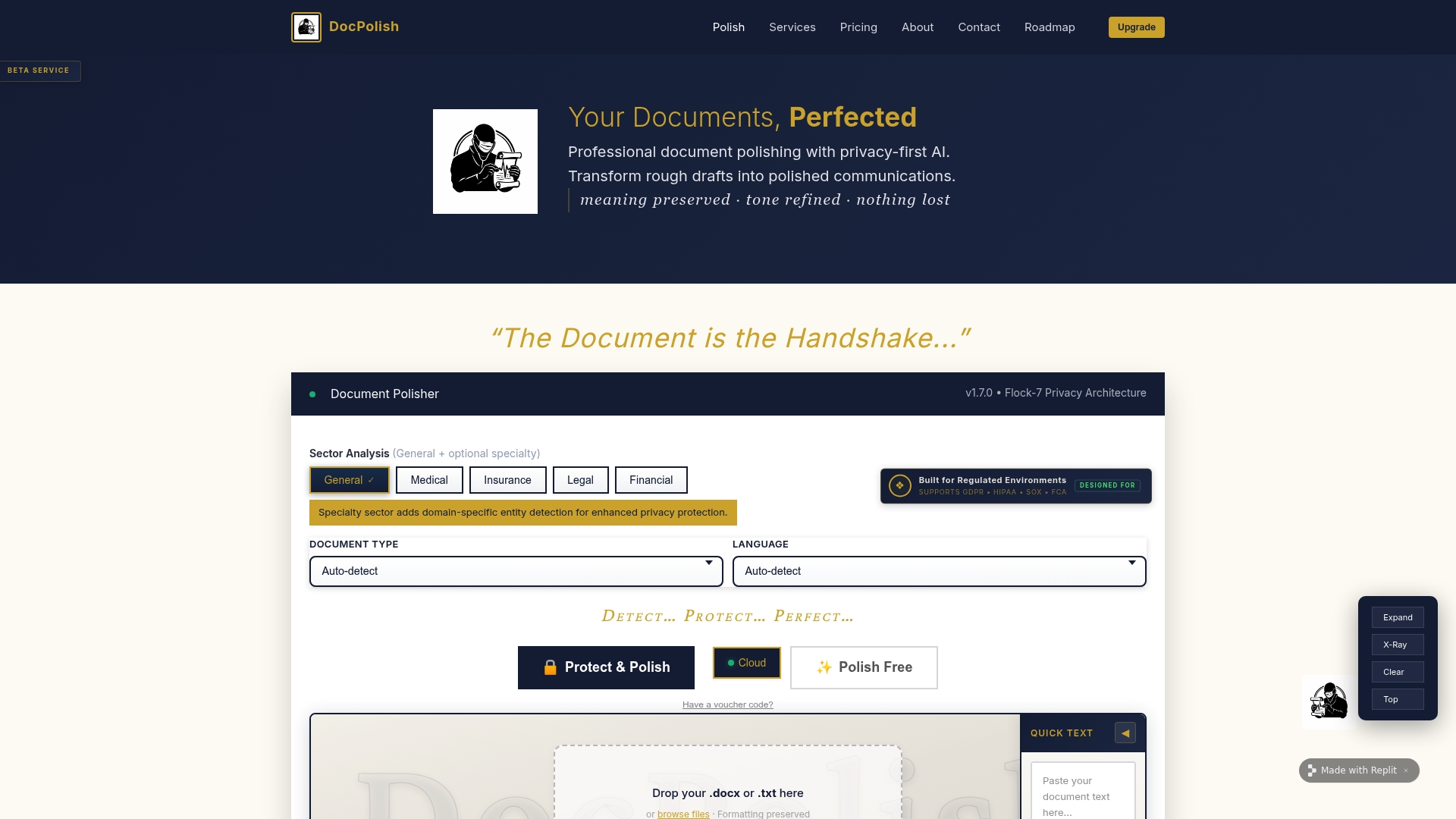
Docpolish is built for exactly this situation. Its client-side PII detection and anonymisation process means sensitive data never leaves the user’s browser before the document is sent for AI polishing. The original PII is restored in the final output, and every processed document receives a trust identifier that supports your audit trail. For legal teams with GDPR or HIPAA obligations, this architecture removes the confidentiality risk that makes standard AI tools unsuitable. Explore how Docpolish handles legal documents to see how it fits your compliance requirements.
FAQ
What is a legal document drafting workflow?
A legal document drafting workflow is a structured process covering request intake, template-based generation, legal review, privilege handling, approval, and archiving. It produces consistent, compliant documents by assigning clear ownership and sequencing at each stage.
How does AI fit into the legal document creation process?
AI handles initial draft generation and clause suggestions, but ABA Formal Opinion 512 requires a qualified lawyer to supervise, review, and take professional responsibility for every AI-generated output before it is used.
What are the steps in document drafting for compliance purposes?
The steps include structured intake, template generation with PII separated from layout, first-pass and quality-control review, privilege review with immutable Bates numbering, approval sign-off, and version-controlled archiving.
How often should a firm review its AI drafting governance policy?
ABA Opinion 512 recommends at minimum an annual review of the firm’s AI policy, covering the approved tool list, training records, confidentiality protocols, and incident response procedures.
What is the biggest risk in an unstructured drafting workflow?
The biggest risk is undocumented AI use combined with absent supervision records. This exposes the firm to professional conduct liability and makes it impossible to demonstrate compliance during an audit or regulatory review.