How secure document drafting in banking works
Secure document drafting in banking is defined as the controlled creation, execution, and storage of financial and legal documents using cryptographic protections, precise legal language, and auditable digital workflows. Understanding how secure document drafting banking works requires examining three interlocking layers: technical security architecture, legal drafting discipline, and automated workflow controls. Tools such as DocuSign and Adobe Sign now sit at the centre of this process, providing digital certificates and audit trails that satisfy both regulatory bodies and courts. The stakes are high. A single ambiguous clause or unencrypted transmission can expose a bank to litigation, regulatory censure, or a data breach affecting thousands of clients.
How does layered security architecture protect banking documents?
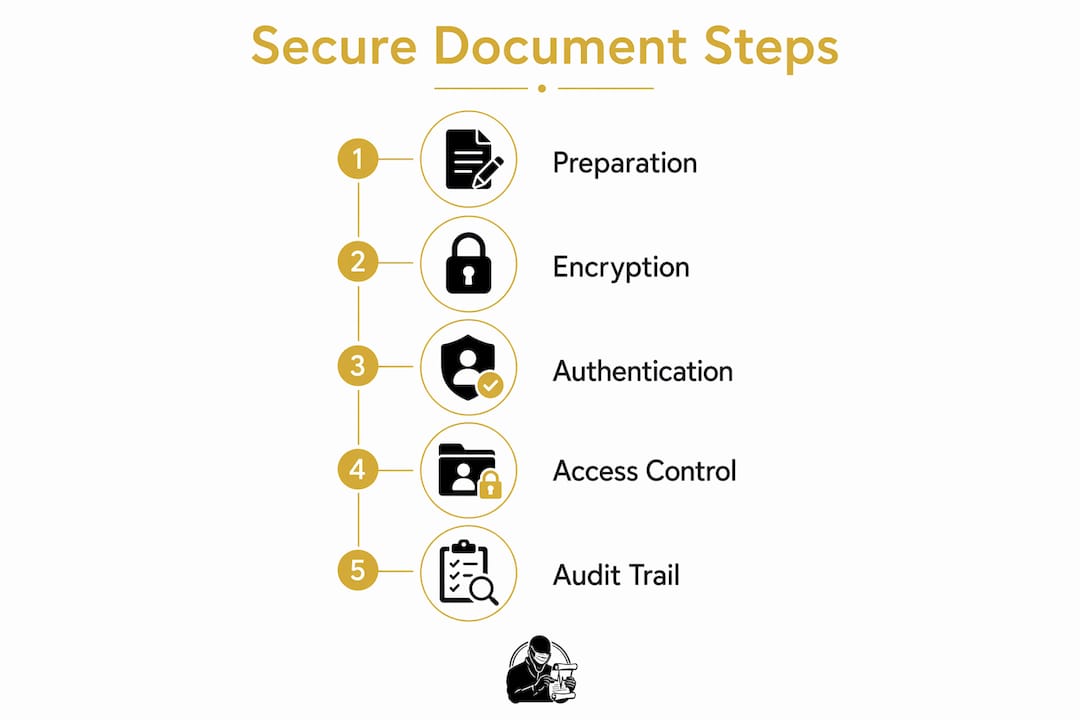
Secure banking document creation relies on a layered security architecture combining digital certificates, role-based access controls, and AES-256 encryption. Each layer addresses a distinct vulnerability in the document lifecycle, from initial drafting through to long-term archiving.
AES-256 encryption and key management
AES-256 encryption protects document content both at rest and in transit. However, encryption alone is insufficient unless key management policies include rotation schedules, strict access controls, and cryptographic isolation for sensitive financial documents. Envelope encryption, where a data encryption key is itself encrypted by a master key, is the recommended approach for mortgage files, treasury instructions, and loan agreements. Without proper key rotation, even strong encryption becomes a liability over time.

Digital certificates and audit trails
Digital certificates generated by signing platforms such as DocuSign capture timestamps, IP addresses, and authentication methods at every document execution event. These certificates have transformed evidentiary standards in finance, providing exhaustive audit details that satisfy regulatory scrutiny and hold up in court. For compliance officers, the audit trail is not a secondary feature. It is the primary proof that a document was executed lawfully. Platforms that integrate with secure cloud environments extend this protection across the full document lifecycle in banking.
Role-based access controls and authentication
Role-based access controls (RBAC) restrict document visibility and editing rights to authorised personnel only. Two-factor authentication adds a second verification layer, reducing the risk of credential theft granting unauthorised access to sensitive drafts. Banks should assign permissions at the role level rather than the individual level, so that staff changes do not create access gaps or orphaned permissions.
Pro Tip: Set document permissions to expire automatically after a defined period. Short-lived access tokens prevent former staff or external counsel from retaining access to live drafts after their engagement ends.
What are the essential legal drafting techniques for banking documents?
Legal drafting techniques are themselves a banking document security measure. Ambiguous language creates exploitable gaps that adversaries, whether litigants or regulators, will use against the institution.
Use defined terms to eliminate ambiguity
Clear and unambiguous contract language reduces litigation risk by leaving no room for varied judicial interpretation. Terms such as “reasonable” or “promptly” carry different meanings across jurisdictions and courts. Replacing them with defined terms, for example “within five business days” instead of “promptly”, removes that interpretive latitude entirely. Every defined term should appear in a definitions clause at the front of the document and be capitalised consistently throughout.
Distinguish ‘shall’ from ‘may’ with precision
The distinction between ‘shall’ and ‘may’ is not stylistic. “Shall” imposes a mandatory obligation; “may” grants a discretionary permission. Confusing the two in a loan covenant or a security agreement can render an obligation unenforceable or, conversely, make a discretionary right appear compulsory. Compliance officers reviewing draft documents should treat every modal verb as a compliance checkpoint.
The term sheet first approach
The “term sheet first” approach requires business and legal teams to agree on commercial terms before full document drafting begins. This early alignment practice prevents costly rework when legal counsel discovers that drafted clauses do not reflect the agreed commercial position. It also ensures that governing law and jurisdiction clauses are calibrated correctly from the outset, which matters enormously for cross-border banking transactions.
- Draft a concise term sheet covering key commercial terms, parties, and governing law.
- Circulate the term sheet to both business and legal stakeholders for sign-off.
- Use the approved term sheet as the binding brief for the full document draft.
- Review the completed draft against the term sheet before execution.
- Archive both the term sheet and the executed document together for audit purposes.
Pro Tip: Treat the term sheet as a compliance document, not just a business summary. Attaching it to the final executed agreement creates a contemporaneous record of commercial intent, which is invaluable if a dispute arises over interpretation.
How do automated drafting tools improve secure document creation?
Automated document workflows reduce human error, enforce compliance, and create auditable digital trails that manual paper-based processes cannot match. The comparison below illustrates the practical difference.
| Factor | Manual drafting | Automated workflow |
|---|---|---|
| Error rate | High: copy-paste errors, version conflicts | Low: templates enforce consistent clause language |
| Audit trail | Incomplete: email chains, paper signatures | Complete: timestamped, identity-verified digital records |
| Compliance enforcement | Reactive: errors found during review | Proactive: workflow rules block non-compliant submissions |
| Access control | Informal: shared drives, email attachments | Formal: RBAC, two-factor authentication, expiring tokens |
| Turnaround time | Slow: manual routing and chasing | Fast: automated approval chains and notifications |
Automated banking document workflows using web forms, integrated identity verification, and no-code workflow builders enforce compliance at the point of data entry, not after the fact. DocuSign’s agreement management platform, for example, connects document generation directly to identity verification and electronic signature, eliminating the gap between drafting and execution where errors most commonly occur. Document classification within these workflows triggers automated approval chains and retention policies, ensuring that a mortgage instruction and a treasury confirmation are handled according to their respective regulatory requirements.
What practical steps should banks take to implement secure drafting workflows?
Implementing secure document drafting workflows requires deliberate choices about templates, permissions, monitoring, and archiving. The following steps reflect current best practice for banking operations teams.
- Centralise template libraries. Legacy document templates frequently contain outdated references and conflicting data that create compliance risk. A centralised, version-controlled template library prevents staff from drafting on obsolete bases.
- Replace email-based document exchange. Secure document intake portals provide identity-based access control and time-limited requests, replacing informal email exchanges that expose sensitive data to interception.
- Implement document classification at intake. Classifying documents at the point of creation triggers the correct approval chain, retention schedule, and encryption policy automatically. This removes the risk of a high-sensitivity document being treated as routine correspondence.
- Monitor for anomalies in document workflows. Automated monitoring tools flag unusual access patterns, such as a user downloading large volumes of documents outside business hours. Early detection limits the damage from insider threats and compromised credentials.
- Conduct regular access reviews. Quarterly reviews of RBAC assignments catch permission creep, where staff accumulate access rights beyond their current role over time.
Pro Tip: Connect your document management system to your identity provider so that when a staff member’s employment ends, their document access is revoked automatically. Manual offboarding processes are the most common source of lingering access vulnerabilities in banking.
For teams managing KYC documentation specifically, the security requirements extend further into identity verification and regulatory requirements for sensitive banking documents, making integrated workflows even more critical.
Key takeaways
Secure document drafting in banking requires layered technical controls, precise legal language, and automated workflows working together to protect document integrity and satisfy regulatory standards.
| Point | Details |
|---|---|
| Layered security is non-negotiable | AES-256 encryption, digital certificates, and RBAC must work together across the full document lifecycle. |
| Language precision is a security control | Defined terms and correct modal verb use prevent ambiguous clauses that create litigation and compliance risk. |
| Term sheet first reduces rework | Aligning business and legal teams before drafting prevents costly revisions and governing law errors. |
| Automation outperforms manual drafting | Automated workflows enforce compliance at the point of entry and produce complete, auditable digital trails. |
| Centralised templates prevent legacy errors | Version-controlled template libraries eliminate the compliance risk introduced by outdated document bases. |
Why the human layer still determines document security
The most underappreciated insight I have gained from working with legal and compliance teams across regulated industries is this: the technology is rarely the weak point. Banks invest heavily in AES-256 encryption and DocuSign integrations, then lose the security benefit because a paralegal emails a draft to external counsel as an unencrypted attachment, or a relationship manager builds a new loan agreement on a four-year-old template they found in a shared drive.
The document drafting best practices that actually reduce risk are the ones that change human behaviour, not just system architecture. The term sheet first approach works not because it is technically clever, but because it forces a conversation between business and legal teams that would otherwise happen too late. Defined terms work not because lawyers enjoy drafting definitions clauses, but because they remove the interpretive freedom that opposing counsel will exploit.
The next significant shift I expect to see in banking document security is not a new encryption standard. It is the integration of AI-assisted drafting tools that flag ambiguous language and non-compliant clauses in real time, before a document reaches the signing stage. The challenge will be ensuring those tools process sensitive financial data without exposing personally identifiable information to external servers. That is a privacy architecture problem, not a drafting problem, and it is one that the industry has not yet fully solved.
My practical recommendation: treat your document workflow audit as a security audit. Map every point where a document leaves a controlled environment, whether that is an email, a download, or a shared link, and close those gaps before investing in more sophisticated encryption.
How Docpolish supports secure document refinement in banking
Banking and legal teams that use AI tools to polish documents face a specific risk: sensitive client data, account numbers, and personally identifiable information can be transmitted to external AI engines during the refinement process.
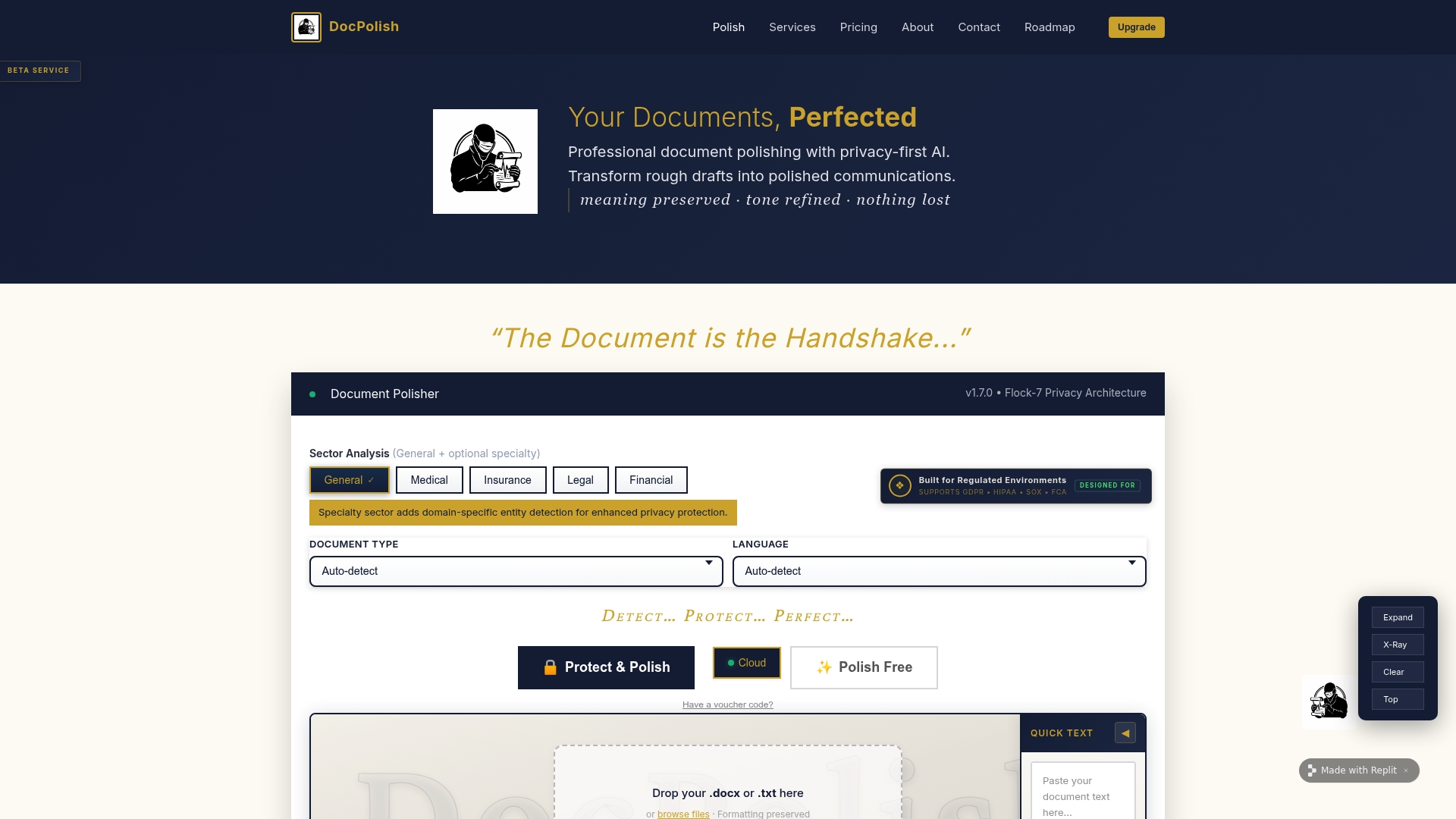
Docpolish addresses this directly. Its client-side approach detects and anonymises PII within the browser before any document content reaches the AI engine. The original data is restored in the final output, meaning the polished document is complete and accurate without sensitive information ever leaving the user’s device. Every processed document receives a trust identifier, creating the audit trail that compliance officers require. For banking teams that need GDPR and regulatory compliance without sacrificing document quality, Docpolish Intelligent Document Refinement provides a privacy-first solution built for regulated industries.
FAQ
What is secure document drafting in banking?
Secure document drafting in banking is the process of creating, executing, and storing financial and legal documents using cryptographic protections, controlled access, and auditable digital workflows. It combines AES-256 encryption, digital certificates, and role-based access controls to protect document integrity throughout the full lifecycle.
Why are digital certificates important in banking document execution?
Digital certificates capture timestamps, IP addresses, and authentication methods at every execution event, creating an immutable audit trail. This trail serves as legal evidentiary proof and satisfies regulatory compliance requirements for banking transactions.
How does the term sheet first approach improve document security?
The term sheet first approach aligns business and legal teams on commercial terms before full drafting begins, preventing rework and ensuring governing law clauses are correct from the outset. Early alignment reduces the risk of ambiguous or non-compliant clauses reaching the execution stage.
What is the risk of using legacy document templates in banking?
Legacy templates frequently contain outdated references and conflicting data that create compliance failures. Centralised, version-controlled template libraries eliminate this risk by ensuring all drafts begin from an approved, current base.
How does automated document workflow improve compliance in banking?
Automated workflows enforce compliance at the point of data entry by using classification rules, approval chains, and identity verification. They produce complete digital audit trails that manual paper-based processes cannot replicate, reducing both human error and regulatory exposure.