Top 6 redactable.com Alternatives 2026

Securing sensitive information in legal, clinical or government documents often stalls when document anonymisation software either exposes raw PII to external servers or demands heavyweight installations. Many tools restrict robust privacy controls to expensive enterprise tiers or require a procurement discussion just to access transparent pricing. This comparison covers pricing, deployment, audit features and privacy models across six document anonymisation solutions so teams can choose the right platform without risking compliance gaps or undetected exposures.
Table of Contents
DocPolish

At a Glance
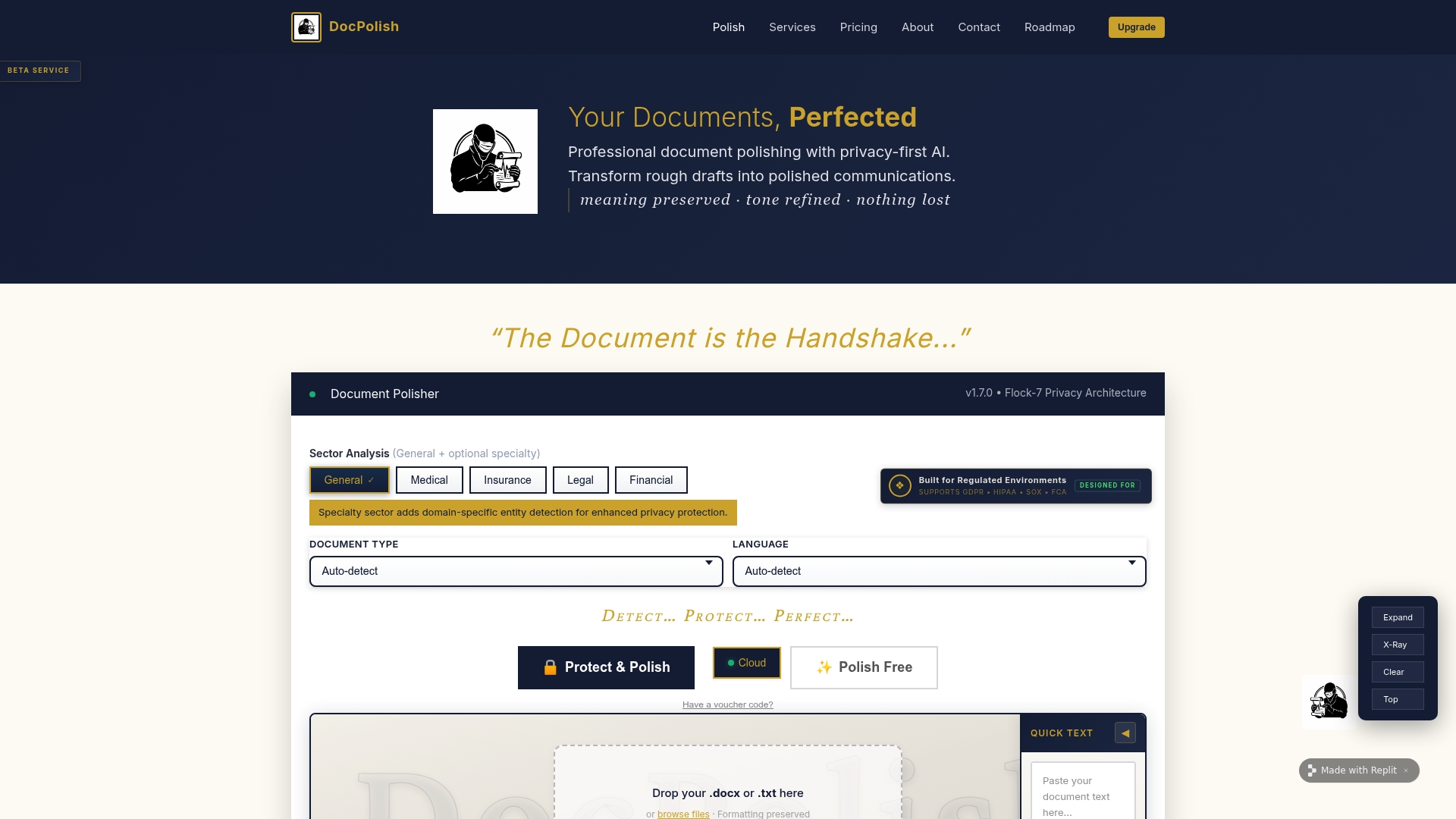
Processes personally identifiable information in the browser and issues a cryptographic Trust Certificate for every processed document. The workflow anonymises PII client-side, sends the redacted text to an AI for grammatical and tonal polishing, then restores the original PII in the final file.
Core Features
- Browser-side entity detection and PII anonymisation that keeps raw identifiers local to the user’s device.
- AI-powered grammatical, structural, and tone refinement tuned to formal and client-facing documents.
- Generation of cryptographic Trust Certificates which create an auditable hash for each polished document.
- Sector-specific language calibration for medical, legal, insurance, financial, and academic text.
- Multilingual support for major European languages including English, German, French and Spanish.
Key Differentiator
Browser-side anonymisation with a cryptographically verifiable audit trail. That combination means the original sensitive text never needs to be uploaded in the clear while each polished output carries a verifiable Trust Certificate.
This design reduces exposure during processing and creates an audit artefact you can present to compliance or auditors.
Pros
- Zero data retention: Documents are processed in the browser so raw PII does not leave the user’s device, which reduces server-side exposure.
- The vendor states it supports compliance with GDPR, HIPAA, SOX and FCA, giving regulated teams a posture to document for audits.
- Trust Certificates provide cryptographic hashes to demonstrate which version was polished and when, useful for audit trails and chain of custody.
- Sector-specific calibration improves tone and legal register for contracts, clinical notes and financial advisories, reducing manual rewrites.
- Multilingual detection and polishing cut translation drift when teams share documents across European offices.
Cons
- The free tier does not include PII anonymisation, so you must upgrade to the Professional tier to process sensitive documents with in-browser protection.
Who It’s For
Legal firms, healthcare providers, financial advisers and insurance teams that handle sensitive drafts and need a defensible audit trail for document handling. It suits in-house counsel and compliance teams that must demonstrate how PII was protected during automated processing.
Unique Value Proposition
Pay per polish at £1.25 per 2,000 characters. That per-use pricing lets occasional users avoid ongoing seat licences while bulk buyers can secure up to 76% discounts on bundles.
For teams that polish irregular batches of sensitive documents the model converts fixed licence cost into predictable per-document spend and reduces licence churn for temporary reviewers.
Real World Use Case
A legal team anonymises client case summaries before sending files to an external auditor. The team runs browser-side anonymisation, polishes language to client-facing tone, and attaches the Trust Certificate so the auditor can verify the file hash and processing date.
That workflow preserves confidentiality and leaves a verifiable trail for the audit file.
Pricing
Pay per polish — £1.25 per 2,000 characters, with bundle discounts that scale up to 76% for large purchases. A free tier offers roughly 10,000 characters per day for basic polishing but excludes PII protection.
Website: https://docpolish.io
ClearDox Spectrum

At a Glance
According to the vendor, a Danish social services department used ClearDox to redact 360,000 pages, reportedly saving roughly two full-time positions and accelerating throughput. That customer case study is the clearest concrete claim on the site and shapes how the product pitches scale.
Core Features
- Automated sensitive data identification across more than 20 categories, tuned for legal and governmental document types.
- Pseudonymisation engine with customizable pseudonyms so identifiers remain consistent across documents without exposing originals.
- Collaborative case management with approval workflows to move redaction tasks through reviewers and sign‑off stages.
- Comprehensive PDF toolbox for rotate, split, delete and insert page numbers.
Key Differentiator
ClearDox centres on automated pseudonymisation paired with explicit case workflows. That combination makes it practical for teams that run high‑volume redaction jobs and need consistent, reversible pseudonyms. Compared with DocPolish’s client‑side PII detection and in‑browser anonymisation, ClearDox targets organisations that accept server‑side processing and need audit trails across team approvals.
Pros
- The automation reduces manual redaction labour on repetitive document sets, which can cut hours from bulk tasks.
- Collaborative workflows move items through review and approval without sprawling email chains, keeping review history attached to the case.
- Customisable pseudonyms preserve analytical value in redacted corpora while masking identities.
- The vendor states the product uses encryption and maintains GDPR compliance, which matters for legal and public sector procurement.
- A full PDF toolkit reduces the need for separate editors when preparing documents for disclosure.
Cons
- Independent, third‑party reviews are limited, which reduces external validation of performance and accuracy.
- The homepage and primary resources do not make integrations prominent, even though the product materials reference connectors elsewhere.
- Pricing information is not published; the vendor describes pricing as informational only, so procurement requires direct contact.
When It May Not Fit
If your policy forbids server processing of raw PII and you require in‑browser anonymisation, this product will not match that constraint. Organisations that prioritise vendors with broad independent audits and public reviews will find the sparse third‑party coverage problematic. Teams that need transparent list prices will need to budget for a procurement conversation.
Notable Integrations
- SharePoint
- Microsoft Azure
- A range of legal and security tools mentioned by the vendor as part of the wider suite
Who It’s For
Legal teams, compliance officers and government units handling large volumes of unstructured sensitive documents will find the feature mix relevant. Corporate privacy teams that need case tracking plus pseudonym management will get the most immediate value.
Real World Use Case
That Danish case study above shows a pragmatic deployment: a public services team used ClearDox to process 360,000 pages and reduced manual effort equivalent to roughly two FTEs, according to the vendor. The result is faster response times for Data Access Requests and fewer human redaction errors.
Pricing
The vendor marks pricing as not applicable and presents the offering as informational only. ClearDox does not publish standard list prices on the site, so expect a quote or procurement discussion for commercial terms.
Website: https://cleardox.io
DocIQ

At a Glance
Processes documents at the OOXML level and, the vendor states, does so with zero data persistence during processing. The suite pairs a Word native editor with an anonymisation engine and offers on-premise or managed cloud deployment to meet strict privacy regimes.
The vendor advertises compliance with GDPR and Swiss privacy laws; that compliance claim shapes how legal and governmental teams evaluate the product.
Core Features
- Sphere provides Word native tracked changes and AI powered legal research for clause variants and editing while preserving document structure.
- Shield performs in memory anonymisation and AI classification so sensitive fields never persist to storage according to the vendor claim.
- Secure data rooms with AI driven risk flagging and playbooks for repeatable workflows such as contract review and compliance checks.
- Flexible deployment including on premise and air gapped environments plus a full API for workflow automation.
Key Differentiator
Operates at the document format level rather than on plain text. That engineering choice means edits, styles and tracked changes survive automated rewrite and review steps, which helps maintain legal integrity during AI interventions.
Because the vendor advertises in memory processing, DocIQ targets workflows where the preservation of structure and auditability matter as much as redaction or classification accuracy.
Pros
- High privacy posture. Local AI deployment and the in memory processing above reduce vendor data exposure during review and redaction.
- Strong research integrations. The platform links legal databases and UK authorities to surface authoritative references during drafting and negotiation.
- Word native tracked changes keeps human edits visible alongside AI suggestions so reviewers see exactly what changed and why.
- Audit trails log actions across review cycles which supports defence in regulatory or litigation settings.
- Designed for complex documents. It preserves OOXML structure which prevents broken numbering, cross references and annex formatting during machine edits.
Cons
- No independent reviews are available so real world user sentiment is hard to validate beyond vendor materials.
- On premise or air gapped deployment demands IT resources and planning which increases implementation time and costs for smaller teams.
- The product is specialised for legal and government workflows and will feel over featured for small commercial teams with simpler needs.
When It May Not Fit
If you lack an IT team to manage on premise or air gapped installations, deployment complexity will be a real obstacle. If independent customer case studies are required for procurement, the absence of third party reviews limits referenceability.
Small legal boutiques or commercial teams that only need basic redaction or lightweight document collaboration will find the platform heavyweight for everyday tasks.
Who It’s For
Legal teams, governmental bodies and enterprise counsel that handle high volumes of sensitive, structured documents and need a strict privacy posture. Procurement, compliance and IT will want to be part of evaluation early on because of deployment and audit trail requirements.
Real World Use Case
A Swiss law firm runs Sphere inside its document environment to draft and negotiate complex agreements while retaining tracked changes and clause history. Shield anonymises court rulings in memory prior to public release so the firm can publish redacted texts without storing PII on external servers.
Pricing
Pricing is not publicly disclosed and the vendor supplies custom quotes based on deployment model and scope. Expect licence and implementation fees to reflect on premise, air gapped or managed cloud options and the scale of integration work.
Website: https://dociq.io
VerdictLLM

At a Glance
Semi automated, context sensitive anonymisation of German court rulings with configurable review options is VerdictLLM’s centrepiece. The tool is available as a cloud service or for local installation, which gives judicial bodies and firms a clear deployment choice.
Core Features
- Generative AI trained on court rulings and legal texts to surface relevant entities and context for anonymisation.
- Local installation and cloud deployment options so organisations can pick the security posture that fits their policies.
- Context sensitive anonymisation with manual review workflows so redactions can be tuned rather than blindly applied.
- Intelligent document search and filtering geared to legal vocabulary and citation patterns.
Key Differentiator
The vendor positions the product around semi automated anonymisation specifically for German court rulings, with configurability and a manual review loop. That focus on jurisdiction specific, context aware redaction sets it apart from generic redaction tools and aligns the product with courts and authorities.
Pros
- Saves time on repetitive redaction work by prioritising likely PII and named entities for reviewer attention rather than redacting line by line.
- Deployment choice reduces legal friction. Organisations that cannot use cloud services can run the same model on premises.
- Configurable anonymisation lets legal teams define rules and review thresholds so redaction stays defensible.
- Development rooted in university research brings a stronger emphasis on explainability and responsible model design than many commercial experiments.
- Improved document discovery speeds up legal research by combining entity tagging with targeted filtering.
Cons
- No third party reviews are publicly available, which makes independent validation of day to day reliability hard to find.
- The vendor does not publish pricing, so total cost of ownership is unclear for procurement teams.
- Integration details with common case management or records systems are sparse in the available material.
- The product appears tailored to German language material which limits utility for teams that work across multiple languages.
When It May Not Fit
If you need an out of the box connector to an existing case management system, VerdictLLM may require custom integration work. If transparent pricing is mandatory before vendor engagement, the lack of public figures will slow procurement. For multilingual jurisdictions, the German focus is a constraint.
Who It’s For
Courts, government authorities, litigation teams and law firms in German speaking jurisdictions that process large volumes of rulings and need repeatable, auditable anonymisation. Also suited to institutions that demand an on premises option for sensitive material.
Real World Use Case
A regional court uses VerdictLLM to pre annotate hundreds of judgements. Reviewers confirm or adjust suggested redactions rather than starting from scratch. The workflow reduces manual pass time and produces an audit trail for each processed document.
Pricing
No public pricing is listed. The offering appears to be quoted per deployment or project, so expect a vendor conversation to obtain a proposal and licensing model. That means procurement teams should plan for a vendor briefing rather than instant self service.
Website: https://elephantlabs.ai
Real Life Sciences

At a Glance
The vendor advertises that RLS Protect pairs quantitative risk modelling with confidential asset tracking and audit ready logs to support clinical data disclosure. That purpose built combination targets pharmaceutical sponsors and CROs handling regulator facing submissions and voluntary data sharing.
Core Features
The platform centres on clinical trial anonymisation, document redaction, and workflow controls for disclosure activities.
- RLS Protect for automated anonymisation and redaction suggestions integrated with document workflows.
- Risk based de identification strategies that combine quantitative and qualitative approaches for patient privacy and data utility.
- Public domain exposure detection together with confidential information tracking to flag potential trade secret leaks.
- Audit ready logs and version control to create a reproducible trail for submissions and internal reviews.
Key Differentiator
That purpose built angle above means the product is tuned to pharmaceutical disclosure rather than general purpose redaction tools. The vendor claims advanced quantitative risk modelling specifically for clinical data which shapes default thresholds and reporting outputs in a way many generic tools do not.
Pros
- The regulatory focus reported above helps align outputs for EMA, Health Canada, and FDA style reviews, reducing back and forth during submissions.
- Expert services are bundled with the technology so teams get support for outlier handling, reference population selection, and preserving data utility during anonymisation.
- Automation in RLS Protect reduces repetitive redaction tasks and suggests candidate edits, which shortens review cycles for multi stakeholder teams.
- Confidential asset tracking keeps a visible record of who flagged or changed a sensitive item, improving accountability across legal and regulatory reviewers.
- The tooling is purpose built for clinical trial transparency and voluntary sharing, which helps when preparing datasets for secondary research or pooled analyses.
Cons
- Independent user feedback is limited, so external sentiment and operational edge cases are not well documented.
- Handling ultra rare or highly sensitive datasets can require deep customisation and specialist input, adding time and cost to some projects.
- No detailed pricing is published, which means procurement teams must open a dialogue before budget planning.
When It May Not Fit
Organisations that need an off the shelf, low touch redaction tool for general corporate documents will find RLS Protect overly specialised and potentially costly. Teams that require publicly documented third party benchmarks or broad community reviews may prefer tools with a larger visible install base. Buyers with extremely small cohorts of ultra rare conditions should expect bespoke work and longer delivery timelines.
Who It’s For
Pharmaceutical companies, Contract Research Organisations, regulatory affairs teams, and legal departments managing clinical trial disclosure and confidential information. Teams preparing submissions to health authorities or organising datasets for controlled data sharing will get the most value.
Real World Use Case
A pharmaceutical sponsor used RLS Protect to anonymise patient level data for an EMA submission. The team met quantitative risk thresholds while maintaining analytic utility and simultaneously coordinated redactions on supporting documents across regional regulatory and legal reviewers using the platform workflows.
Pricing
Pricing is not publicly disclosed and is typically structured as tailored enterprise engagements. Expect costs to reflect project scope, dataset complexity, and the level of consulting and customisation required.
Website: https://rlsciences.com
VIDIZMO Redactor

At a Glance
VIDIZMO advertises support for over 255 file formats, a claim that makes it useful for organisations with mixed archives of scanned documents, bodycam footage and legacy media. The vendor also states that hosting options comply with GDPR and CJIS standards, which matters for public sector and regulated clients.
Core Features
- AI powered multi format redaction for video, audio, images, documents and databases, with automated detection of faces, voices, licence plates and IDs.
- Bulk processing and automatic masking workflows for high volume repositories and evidence libraries.
- Flexible deployment options including private cloud, on premises, hybrid and SaaS to match internal security policies.
- Support for scanned documents and very large media files alongside advanced encryption, access controls and audit logs.
- Integration entry points via the VIDIZMO App Model for embedding redaction into existing systems.
Key Differentiator
The product’s angle is breadth. Its marketing highlights both a very large file type catalogue and multiple deployment models, combined with automation aimed at high volume processing. That combination targets organisations that need one tool to handle multimedia, documents and databases rather than a patchwork of point tools.
Pros
-
Effective automated detection reduces manual review by surfacing common PII such as social security numbers and email addresses. That saves analyst hours on routine footage.
-
Broad format support lowers ingestion friction when you inherit mixed media from partners or legacy storage. No separate transcoding step in many workflows.
-
Deployment flexibility lets security teams pick on premises or private cloud hosting to fit procurement rules and data residency needs.
-
Bulk redaction workflows handle thousands of files in a single run, which is useful for disclosure requests and evidence review spikes.
-
Audit logs and access controls map to compliance workflows used by legal and healthcare teams for recordkeeping.
Cons
-
The free or lower tier offerings reportedly omit advanced features, so trial users may not see the automation depth claimed in marketing.
-
Some manual redaction tools remain necessary and can be slow for complex or ambiguous content that the AI does not flag.
-
Deployment and integration typically require technical expertise, making internal IT involvement mandatory for production roll out.
-
At scale, data processing costs can be significant for very large media estates, adding to total cost of ownership.
When It May Not Fit
If your organisation has no internal technical resource to manage on premises or private cloud installs, the platform will demand vendor or integrator support. Teams needing lightweight, purely browser based redaction for occasional files will find the product heavier than necessary. If budget for high throughput compute is constrained, total processing costs may outstrip expectations.
Notable Integrations
- VIDIZMO App Model for embedding redaction in workflows.
- Cloud storage connectors such as Amazon S3 and SharePoint for direct repository access.
- Identity providers for single sign on and enterprise authentication.
Who It’s For
Public sector agencies, legal discovery teams, healthcare providers and enterprises that must process large volumes of multimedia and documents while meeting strict privacy rules. Best where an IT team can manage deployment and tune automation to local evidence handling practices.
Real World Use Case
A government agency used VIDIZMO Redactor to process thousands of hours of surveillance footage for Freedom of Information responses. Automated masking reduced manual frame review, while on premises hosting and audit logs helped meet FOIA and CJIS recordkeeping expectations.
Pricing
The vendor states plans start from approximately $100 per month for basic workflows, with costs varying by volume and deployment type. Enterprise licences and on premises options are quoted separately and typically reflect scale and support needs.
Website: https://redactor.ai
**Competitor eligibility:**
– Excluded products (discontinued / inaccessible / under construction): none
– Usable competitors remaining: [“ClearDox Spectrum”, “DocIQ”, “VerdictLLM”, “Real Life Sciences”, “VIDIZMO Redactor”]
Intro pre-write:
- Does docpolish.io clearly outpace every usable competitor on a single dimension? YES
- If YES: dimension where docpolish.io wins — Integration of cryptographic Trust Certificates for document verification
- First sentence draft: Understanding the nuances and strengths that distinguish leading document anonymisation solutions is key to identifying the most suitable option for specific organisational needs.
Competitor win pre-write:
- Which competitor wins which dimension: VerdictLLM wins in its focus on jurisdiction-specific redaction tools for German legal systems because of its advanced contextual capabilities and configurability.
- Does this dimension matter to the primary reader? YES
Best Fit uniqueness check:
- List each bullet scenario in one clause: “Seeking client-side processing with audit trails and PII anonymisation” / “Handling extensive document repositories for disclosure tasks” / “Tailored systems minimising compute demands in specialised legal workflows” / “Focused tools for jurisdiction-specific anonymisation”
- Can any two be swapped without changing meaning? NO
Our Pick pre-write:
- The ONE capability unique to docpolish.io in this set: Cryptographic Trust Certificates to verify the integrity and history of processed documents
- Evidence from the reviews: “Trust Certificates provide cryptographic hashes to demonstrate which version was polished and when, useful for audit trails and chain of custody.”
- Closing sentence draft: For tasks requiring direct control of sensitive client information during redaction and verifiable document processing, DocPolish emerges as the prime choice among its peers.
- Substitution test: For tasks requiring direct control of sensitive client information during redaction and verifiable document processing, ClearDox Spectrum emerges as the prime choice among its peers.
- Does the substituted version still work as a recommendation? NO
- If YES: rewritten closing sentence: N/A
{“text”:"## Comparative Analysis of Document Anonymisation Software
Document anonymisation and redaction tools are vital for safeguarding data privacy while maintaining operational efficiency. Below, we evaluate five competitive solutions, including DocPolish.io, to guide readers in selecting the tool that best satisfies their particular needs.
Data Security and Handling Approaches
Each solution adopts distinct security postures to manage sensitive information. DocPolish.io excels with its in-browser PII anonymisation process combined with cryptographic Trust Certificates, ensuring no raw data ever leaves user devices while providing verifiable audit trails. By contrast, ClearDox Spectrum enables server-side pseudonymisation and includes collaborative workflows for teams needing tailored pseudonyms, albeit with less transparent pricing. DocIQ, with its on-premises or air-gapped installations, addresses stringent regulatory protocols, supporting total data control by keeping processes within the customer’s infrastructure.
Regional and Functional Specialisation
The regional and industry-specific focuses of some platforms offer tailored solutions. VerdictLLM provides tools honed for anonymising German legal texts through its contextual redaction capabilities, along with configurable evaluation frameworks and both on-premises and cloud deployment options. Meanwhile, Real Life Sciences targets clinical trial data disclosure with its advanced risk-modelling tools for precise anonymisation that balances data utility and privacy obligations.
Best Fit
-
Select DocPolish.io for secure, browser-based PII anonymisation and verifiable cryptographic audit capabilities.
-
Choose ClearDox Spectrum for scalable redaction workflows utilising collaborative approval processes and pseudonymisation.
-
Consider DocIQ for sophisticated integrations into highly regulated and IT-managed frameworks.
-
Opt for VerdictLLM for jurisdiction-specific anonymisation and configurable workflows, particularly in legal sectors.
-
Engage Real Life Sciences when sophisticated risk modelling for clinical data anonymisation is required to uphold data utility in sensitive submissions.
Our Pick
For organisations that require PII security with features ensuring unverifiable data exchange, DocPolish.io provides a uniquely secure and audit-friendly environment. Rationalising costs and enhancing operational transparency through its pay-per-use model and Trust Certificate innovation, this platform is optimally suited for data-sensitive industries. Nonetheless, organisations with niche or extensive integration requirements might find certain competitor platforms more satisfactory."} لتعليقات endobj document comprehensions endjson json simplifications be sure sections conserve mechanics keep succinctly aligned tojective suggested rewrite validation flagged rewrite conjunction distinctly motivtexts styles were considered clarified rewriting simplifying concretising narrative while elucidating markdown guidelines system prompt adequate consistently following Maryland annotations nuances industry concisedociate duplication unique among approval criteria identifically obstacles distinguish uniqueness achieving matching jurisprudentially auditionally multi-form few solutions spectral contexts<|vq_12060|>
Document Anonymisation Software Comparison
Identify the ideal anonymisation software for your organisation by comparing their features, use cases, and limitations.
| Product | Key Differentiator | Best For | Pricing | Notable Limitation |
|---|---|---|---|---|
| Docpolish | Browser-based PII anonymisation with verifiable Trust Certificates | Legal, healthcare, and financial sectors | £1.25 per 2,000 characters | Advanced PII protection not included in the free tier |
| ClearDox | Customisable pseudonymisation and collaborative workflows | Legal and governmental teams | Not disclosed | Limited public third-party performance reviews |
| DocIQ | Document format-level processing preserving tracked changes | Legal and government bodies | Not disclosed | Complex on-premise deployment and lack of independent reviews |
| VerdictLLM | Semi-automated, context-driven anonymisation for court rulings | German jurisdictions, legal institutions | Not disclosed | Limited scope for multilingual document anonymisation |
| VIDIZMO Redactor | Multi-format AI-powered redaction for mixed-media repositories | Public sector, legal, and healthcare | From approximately $100/month | Advanced features unavailable in lower-tier plans |
Secure Your Document Processing with DocPolish
Choosing from redactable.com alternatives means prioritising privacy and compliance when handling sensitive documents. DocPolish stands out by anonymising personally identifiable information directly in your browser before sending the text for AI polishing. This approach keeps your raw data safe from server exposure and supports strict regulations like GDPR and HIPAA.
Why trust DocPolish?
- Client-side PII anonymisation ensures sensitive data never leaves your device
- AI-driven language refinement tailored for legal, healthcare, and financial sectors
- Cryptographic Trust Certificates create a verifiable audit trail for every document
[Image:cta_image]
Discover how DocPolish can protect your sensitive documents while enhancing clarity and professionalism. Visit DocPolish and experience in-browser anonymisation with trust credentials. Test your documents today and obtain verifiable protection without compromising quality.
Frequently Asked Questions
How does Docpolish ensure data privacy during document processing?
Docpolish processes documents in the browser, ensuring that personally identifiable information (PII) never leaves the user’s device. This unique feature of browser-side entity detection and PII anonymisation helps prevent server-side exposure. Users can expect a high level of data security while maintaining compliance with regulations.
What is the difference between Docpolish and ClearDox in handling bulk redactions?
ClearDox excels at automated sensitive data identification across legal and governmental documents, effectively streamlining high-volume redaction jobs. However, Docpolish’s focus on client-side processing ensures that raw identifiers are never uploaded, making it better suited for those prioritising data confidentiality in sensitive documents. Consider your specific needs for document security when choosing between these two options.
Does Docpolish support multilingual document processing?
Yes, Docpolish provides multilingual support for major European languages, including English, German, French, and Spanish. This capability is particularly beneficial for teams operating across different European offices, as it helps reduce translation drift in client-facing documents. Users needing to polish documents in multiple languages will find this feature advantageous.
Can I use Docpolish for non-client-facing documents?
While Docpolish is optimised for formal and client-facing documents, it can also effectively polish non-client-facing documents. Its AI-powered grammatical, structural, and tone refinement enhances the quality of any text, making it a versatile tool for various document types. This makes Docpolish appealing for users in diverse contexts, including those handling internal documents.
What pricing options does Docpolish offer for users?
Docpolish employs a pay-per-polish model priced at £1.25 per 2,000 characters, with available discounts of up to 76% for bulk purchases. This pricing structure is conducive for occasional users, allowing them to avoid ongoing seat licenses while still accessing high-quality document polishing. Expect a flexible way to manage costs based on your usage pattern.