
PII detection explained for compliance professionals

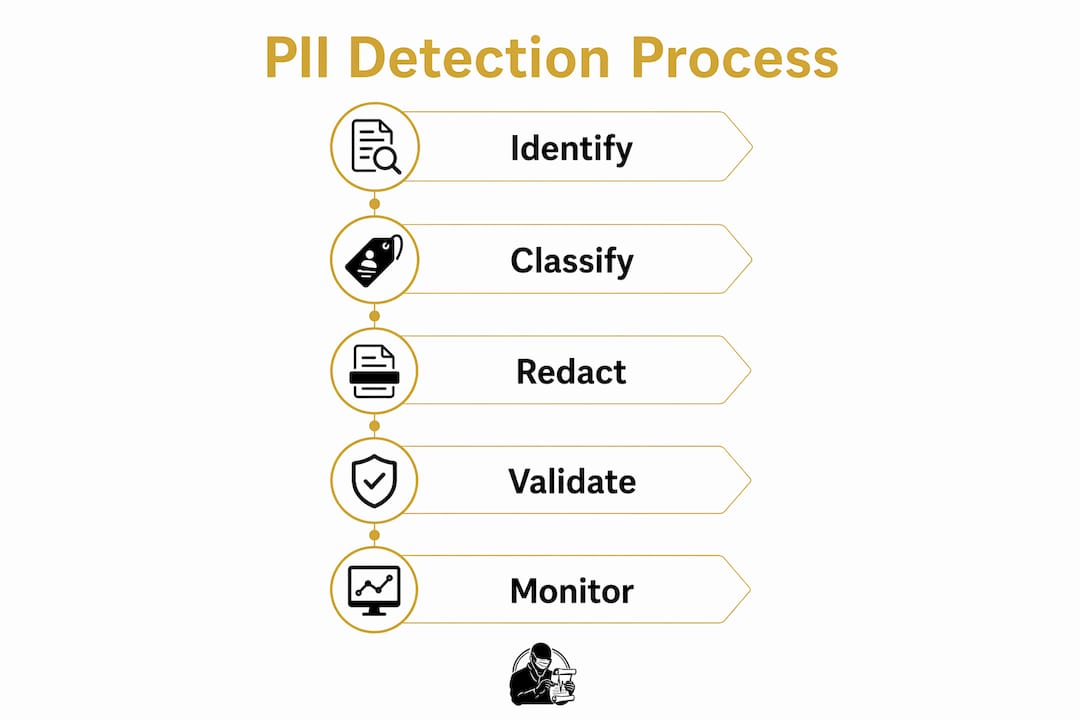
PII detection is defined as the automated process of identifying, classifying, and redacting personally identifiable information across text, conversations, and documents to enforce privacy controls. For compliance professionals in healthcare, legal, and finance, understanding PII detection methods is not optional. Regulations like GDPR and HIPAA require it. Tools such as Azure Language, OpenAI Privacy Filter, and Cloudflare AI Security each approach the problem differently, and choosing the wrong method for your data type creates both legal exposure and operational disruption. This article unpacks what is PII detection explained in practical terms, covering detection methods, implementation challenges, and best practices for regulated workflows.
What is PII detection and why does it matter?
PII detection automatically identifies, classifies, and redacts personal data inside text, conversations, and documents to enable privacy controls. The scope of what counts as personally identifiable information is broader than most professionals assume. Names, email addresses, national insurance numbers, passport IDs, credit card details, IP addresses, and biometric data all qualify. Any information that can identify a specific individual, alone or in combination, falls under the PII umbrella.
The stakes are high. GDPR fines can reach €20 million or 4% of global annual turnover, whichever is greater. HIPAA civil penalties reach up to $1.9 million per violation category per year. Detection is the first line of defence. Without it, sensitive data flows unchecked through storage systems, AI pipelines, and third-party tools.

Azure Language’s PII detection returns entity categories with confidence scores alongside redacted results. It operates across three modes: text, conversation, and document. That distinction matters because a real-time chat transcript requires different processing logic than an asynchronous PDF upload. Selecting the wrong mode introduces latency or missed detections, both of which carry compliance risk.
What methods are used to detect PII in different data types?
Detection methods fall into three broad categories, each suited to a different data structure and compliance requirement.
-
Regex and checksum validation targets structured PII. Credit card numbers, sort codes, national insurance numbers, and postcodes follow predictable patterns. Regex rules match those patterns with high speed and low computational cost. Checksum validation adds a second layer, confirming that a detected number is mathematically valid, not just pattern-shaped. Structured PII is detectable via regex with checksum validation, but this approach fails entirely on natural language names and addresses.
-
Named Entity Recognition (NER) and transformer-based models handle unstructured PII. A person’s name embedded in a legal brief, a home address mentioned in a clinical note, or a patient’s date of birth referenced in a conversation transcript cannot be caught by regex. NER models, trained on labelled corpora, identify these entities by context and position within a sentence. Transformer architectures, such as those underpinning OpenAI Privacy Filter, extend this further with bidirectional token classification that reads surrounding context before making a classification decision.
-
Hybrid layered pipelines combine both approaches. A tiered detection approach runs cheaper, faster detectors first and reserves costly AI models for complex or high-sensitivity data paths. This controls both latency and cost without sacrificing coverage.
Pro Tip: Map your data types before selecting a detection method. Structured fields like form inputs suit regex; free-text fields like clinical notes require NER or a transformer model. Mixing these up wastes budget and creates compliance gaps.
The tradeoff between latency and accuracy is real. Regex runs in milliseconds. A transformer model processing a 10,000-word document may take several seconds. For real-time applications, that gap is operationally significant. Tiered pipelines solve this by routing data to the appropriate detector based on sensitivity classification, not processing everything through the most expensive model.
How do ai-powered models improve on traditional pattern matching?
Traditional pattern matching works well for what it was designed to do: catch known, structured identifiers. The problem is that most sensitive data in regulated industries lives in unstructured text, where context determines whether a piece of information is identifying.
Consider the phrase “John attended the clinic on 14 March.” A regex rule cannot flag “John” as PII without additional context. A trained NER model recognises “John” as a person entity. A transformer model goes further, inferring from surrounding text that this is a clinical record and elevating the sensitivity classification accordingly.
OpenAI Privacy Filter provides context-sensitive detection and masking, running locally to prevent data leakage during the detection process itself. Running detection locally is a critical architectural choice. Sending documents to an external API for PII scanning creates a secondary exposure risk, particularly for healthcare and legal data.
Key advantages of AI-powered detection over pure regex include:
- Detection of subtle, context-dependent identifiers that have no fixed pattern
- Reduced false positives through contextual disambiguation
- Support for a broader taxonomy of personal identifiers, including secrets and credentials
- Tunable sensitivity thresholds that can be adjusted to match regulatory requirements
“Contextual PII detection and tunable sensitivity are crucial to avoid missing subtle personal information or over-censoring in regulated industries.” — OpenAI Privacy Filter guidance
Tunable operating points are particularly valuable in regulated settings. A financial services firm processing loan applications needs higher recall on financial identifiers than a marketing team processing survey responses. The ability to adjust sensitivity per category, rather than applying a single global threshold, is what separates production-grade detection from a generic tool.
What are the implementation challenges in AI pipelines?
PII does not enter AI systems through a single door. PII must be detected throughout AI system data flows: inputs, retrieved context, tool calls, and model outputs. Each entry point is a potential breach vector. A system that scrubs user inputs but ignores retrieved database context will still expose PII in the model’s response.
Mutation mode vs validation mode
Two operational modes define how a detection system responds when PII is found.
| Mode | Behaviour | Best Use Case |
|---|---|---|
| Mutation (Redaction) | Substitutes detected PII with a placeholder before processing | Cleaning prompts before sending to an AI model |
| Validation (Blocking) | Rejects the request entirely if PII is detected | Enforcing strict compliance at a gateway layer |
Mutation mode substitutes detected PII with placeholders; validation mode enforces strict compliance by blocking the request. The choice between them depends on whether the workflow can tolerate a modified input or requires a hard stop.
Managing false positives
Broad PII detection flags generate false positives; production systems should build rules on required PII categories to avoid blocking legitimate traffic. A rule that flags every date as PII will block appointment confirmations, contract dates, and invoice timestamps. That is not compliance. That is operational failure.
The recommended approach is to start with a narrow set of high-confidence categories, monitor the false positive rate, and expand scope gradually. Cloudflare’s guidance on narrowly scoped detection categories reflects this principle directly.
Pro Tip: Document your detection coverage by PII class from day one. Auditors in regulated industries will ask which categories your system covers and which it does not. A documented coverage map is far easier to defend than a verbal explanation.
Tiered detection stacks increase efficiency by running low-latency detectors on every request and reserving high-latency AI models for flagged or high-sensitivity paths. This architecture controls cost without reducing compliance coverage on the data that matters most.
What are the best practices for PII detection in regulated industries?
Effective PII management in regulated industries requires more than deploying a detection tool. It requires a governance framework that treats detection as a continuous process, not a one-time configuration.
-
Scope detection categories to your actual policy. Not every organisation needs to detect every possible PII type. A legal firm handling client contracts needs to prioritise names, addresses, and financial identifiers. A hospital needs to prioritise patient IDs, diagnoses, and contact details. Aligning detection scope to policy reduces false positives and focuses compliance effort where it counts. Guidance on what counts as patient PII is a useful starting point for healthcare teams.
-
Apply detection upstream, before data storage or sharing. Detection applied after data has been stored or transmitted is remediation, not prevention. Privacy controls belong at the point of ingestion, before data reaches analytics platforms, AI models, or third-party processors.
-
Use documented, auditable detection methods. Documentation of detection coverage by PII class aids compliance teams during audits. Every detection rule, every category in scope, and every exception should be recorded. Regulators expect evidence of a systematic approach, not ad hoc responses.
-
Monitor and refine detection rules continuously. Data types evolve. New regulations introduce new categories. A detection configuration that was compliant in 2024 may be insufficient in 2026. Build a review cycle into your compliance calendar, not just your incident response plan.
-
Integrate detection across the full data lifecycle. Detection at the input layer alone is insufficient. Retrieval-augmented generation systems, for example, pull context from databases at query time. That retrieved context must also be scanned. Professionals handling sensitive data documents need detection coverage at every stage, not just at the front door.
Key takeaways
Effective PII detection requires layered methods, scoped policies, and coverage across every point in the data pipeline, not just at input.
| Point | Details |
|---|---|
| Detection methods must match data type | Use regex for structured fields and NER or transformer models for unstructured text. |
| AI models outperform regex on context | Tools like OpenAI Privacy Filter detect subtle, context-dependent PII that pattern matching misses. |
| Cover all pipeline entry points | Scan inputs, retrieved context, tool calls, and model outputs to prevent indirect PII exposure. |
| Narrow detection scope to reduce false positives | Start with high-priority PII categories and expand gradually based on monitored results. |
| Document coverage for audit readiness | A written record of detection categories and methods is required evidence in regulated industry audits. |
PII detection in 2026: what i have learned from working in regulated environments
The compliance teams I have worked with consistently underestimate one thing: the gap between having a PII detection tool and having a PII detection strategy. Those are not the same thing.
Most organisations deploy a detection layer, configure it once, and treat the job as done. Then a new AI feature gets added to the product. Or a third-party integration starts pulling data from a customer database. Suddenly there is a new pipeline entry point that nobody scanned during the original setup. That is where breaches happen. Not through dramatic failures, but through quiet gaps in coverage that nobody thought to check.
What I find most encouraging about the current generation of tools is the shift toward tunable, context-aware detection. The ability to adjust sensitivity per PII category, rather than applying a blunt global threshold, is genuinely useful for regulated workflows. A legal team processing confidential client documents needs different settings than a finance team processing payroll data. One-size-fits-all detection is a liability, not a safeguard.
The uncomfortable truth is that most organisations are not over-detecting. They are under-documenting. The detection may be working. The audit trail may not exist. Regulators do not just want compliant systems. They want evidence of compliant systems. Build the documentation habit before you need it, not after a regulator asks for it.
Secure document editing with Docpolish
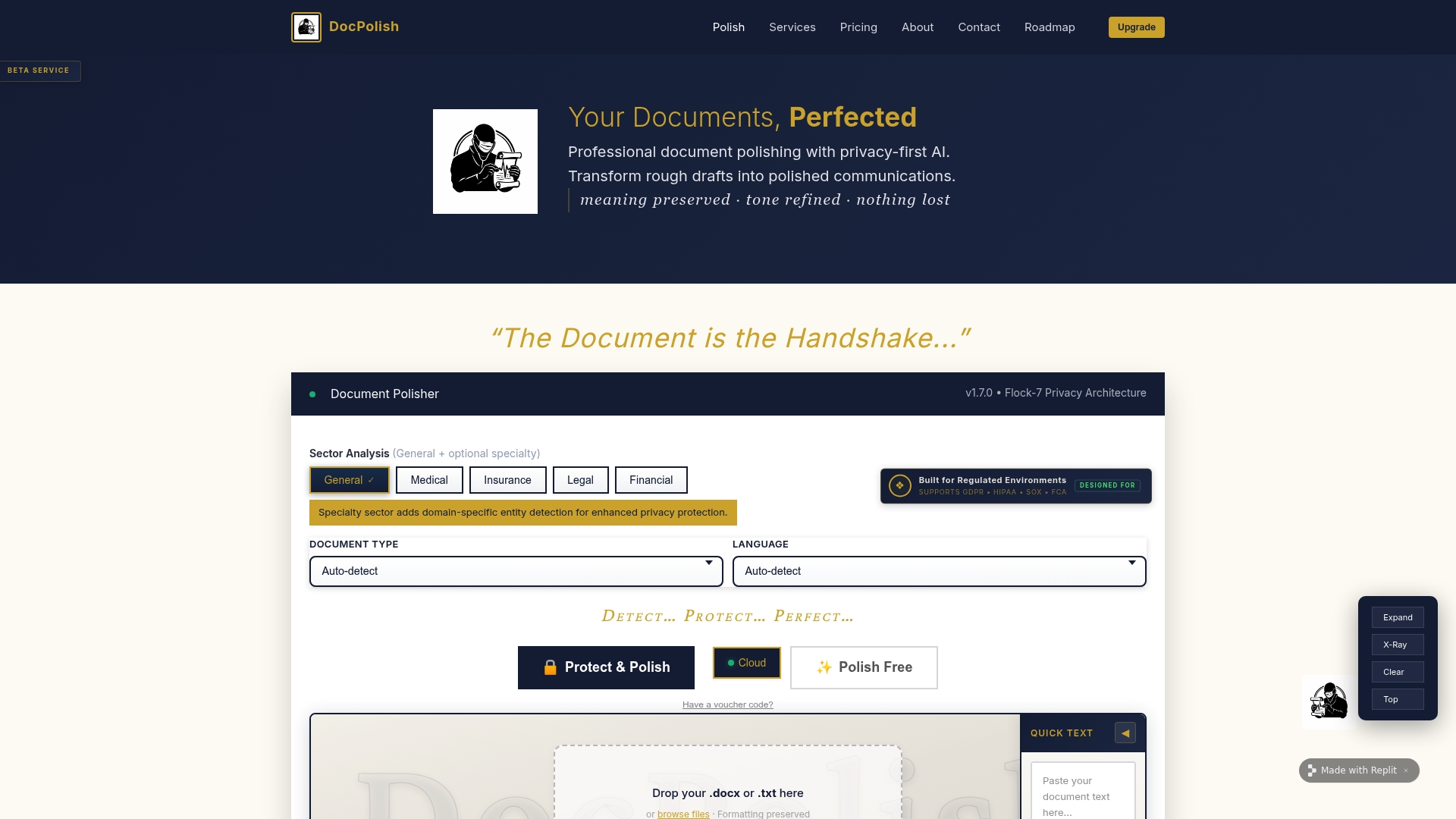
Docpolish is built specifically for professionals in regulated industries who cannot afford to send sensitive documents to an external AI without privacy controls in place. Its client-side PII detection and anonymisation process means that personal data never leaves your browser. Documents are anonymised before reaching the AI polishing engine, and the original PII is restored in the final output. Every processed document receives a trust identifier, creating an auditable record that satisfies GDPR and HIPAA requirements. For compliance teams that need professional document quality without privacy compromise, Docpolish secure document editing is the practical solution.
FAQ
What is personally identifiable information?
Personally identifiable information is any data that can identify a specific individual, including names, email addresses, government IDs, financial account numbers, and biometric data. When combined, even non-identifying fields can become PII.
How does PII detection work in practice?
PII detection uses regex for structured data like credit card numbers, and NER or transformer-based AI models for unstructured text like clinical notes or legal briefs. Most production systems combine both in a tiered pipeline.
What is the difference between mutation mode and validation mode?
Mutation mode replaces detected PII with a placeholder before processing continues. Validation mode blocks the request entirely if PII is found, enforcing a hard compliance boundary.
Why do ai-powered detection tools outperform regex alone?
AI models read surrounding context before classifying a token, allowing them to detect names, addresses, and other identifiers that have no fixed pattern. Regex cannot do this for natural language text.
How many PII categories should a compliance team detect?
Start with a narrow set of categories directly relevant to your regulatory obligations, monitor false positive rates, then expand scope gradually. Broad detection without tuning creates operational disruption without improving compliance outcomes.